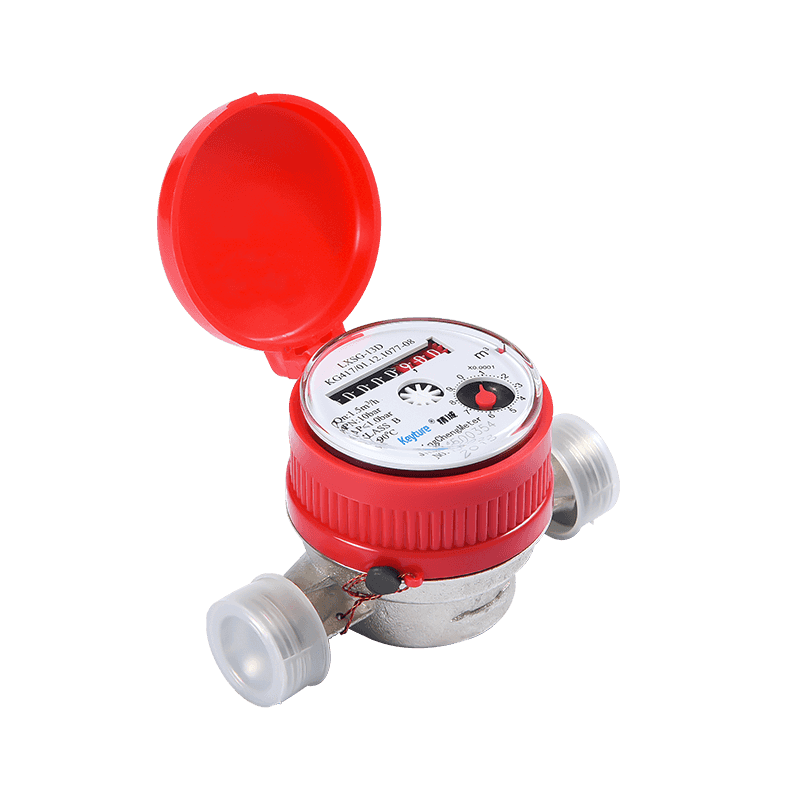
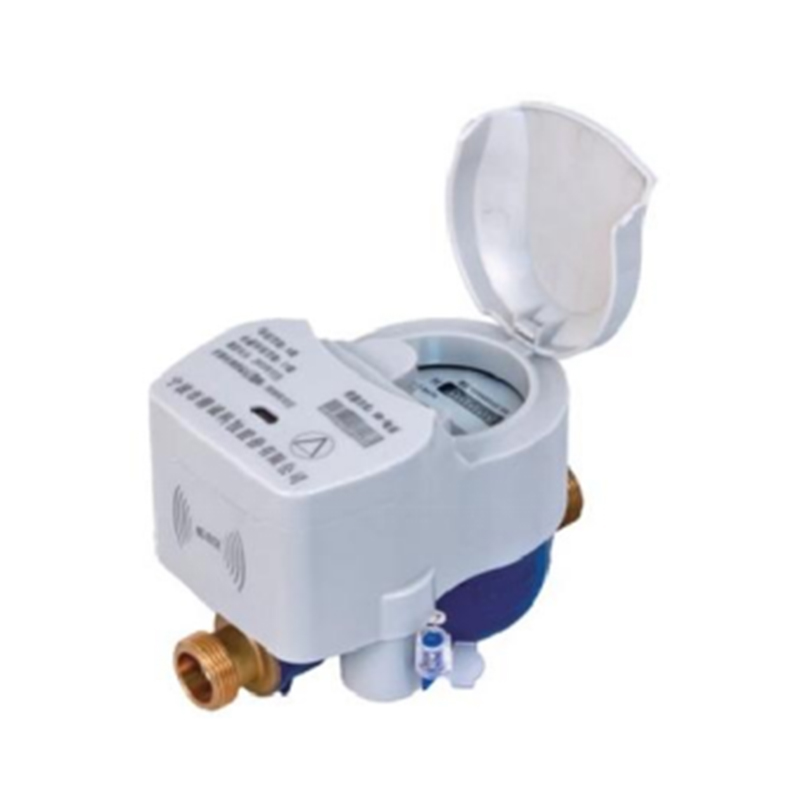
Open the chamber lid, clear the glass if it has fogged over, and read the entire register from left to right before planning anything else. A household meter normally shows three to five black digits for whole cubic metres, two or three red digits or a small graduated dial for fractions, and a separate low-flow indicator that moves whenever water passes through the measuring chamber.
The low-flow indicator is the part that does the real work in a leak check. On multi-jet and single-jet meters it is usually a small star wheel or a fine-toothed dial that turns at roughly one revolution per litre, which is far faster than the main sweep hand. On rotary-piston volumetric meters it may be a toothed wheel behind the window or a coloured disc that pulses as the piston oscillates. If your meter has no separate indicator at all, the sweep hand still works, but one full turn often represents 10 litres on a DN15 multi-jet, so you need to watch it for a longer period before drawing a conclusion.
Write down the full reading, including the red digits, on a piece of paper or in a phone note. Photograph the register as well. A photograph removes the most common source of argument later: misremembering whether the last digit was a seven or a one.
| Element | Typical appearance | What it shows | Use during a leak test |
|---|---|---|---|
| Whole cubic metres | Black digits on white rollers | Billed volume | Record start and end values |
| Fractional digits | Red digits or a red dial | Litres and tens of litres | Detects movement the main digits miss |
| Low-flow indicator | Star wheel, fine dial or coloured disc | Any continuous flow | Fastest visual signal of a leak |
| Sweep hand | Long pointer, one turn per set volume | Medium to high flow | Backup when no indicator exists |
Thirty minutes is the practical minimum. Shorter windows produce false negatives because a slow cistern refill, an ice maker cycle or a softened-water regeneration can pause for several minutes and then restart. Set a timer and leave the property completely quiet for the whole period.
A meter that moves during the silent test is giving you a direction, not a diagnosis. The next question is always where the water is going, and that requires a second pass through the property rather than a second reading at the meter.
If the property is a rental unit or a commercial site with multiple tenants, the boundary valve at the meter is your test point. Close it and confirm the meter stops. If it keeps turning with the boundary valve shut, the loss sits between the meter and that valve, which is the utility's side of the responsibility line in most supply agreements.
Most leak tests fail on arithmetic rather than on plumbing. A register reading of 01234.567 means 1,234 cubic metres and 567 litres, not 12,345 cubic metres. The decimal position moves depending on the model, and a meter that reads in cubic feet instead of cubic metres changes the conversion by a factor of roughly 28.3.
The rolling-dial trap is more subtle. On an odometer-style register, the last digit may sit half way between two numbers while the next wheel is about to turn. Read the lower value and note that the wheel is transitioning. If you record the higher value by mistake, the second reading will appear to show negative consumption and the whole test looks invalid.
| Mistake | What it looks like | Effect on the result |
|---|---|---|
| Ignoring red digits | Only whole cubic metres written down | Small leaks disappear entirely |
| Reading cubic feet as cubic metres | Unit marking missed on the dial face | Volume overstated by about 28 times |
| Rounding a rolling wheel upwards | Digit sits between two numbers | Apparent negative consumption |
| Testing during an appliance cycle | Ice maker or softener restarts | False positive leak alarm |
For a step-by-step walkthrough of register reading in general, the site's guide on how to check your water meter covers the dial types in more detail. Keep the units question separate from the leak question, though; they are two different skills and mixing them up is where most home investigations stall.
Several legitimate water uses run silently and continuously for part of the day. Before any excavation is discussed, rule these out. A meter that turns only during a specific hour is usually following an appliance, not a broken pipe.
These refill on a float or timer and can draw several litres per cycle, often at night when the kitchen is quiet.
A regeneration can pass a few hundred litres over twenty to forty minutes, then stop completely for days.
The tank tops up whenever pressure drops, producing a slow trickle that looks identical to a pinhole leak.
A failing inlet valve refills in short bursts and is the single most common cause of a spinning indicator.
Thermal expansion on a closed system can push a small volume back through a check valve arrangement.
Some humidifier and evaporative systems draw water intermittently through the day and night.
If none of these apply and the indicator still turns, you have a genuine reason to trace pipework. The order of investigation matters: fixtures first, then accessible pipework, then buried lines.
Every meter has a minimum flow rate below which it does not register, usually designated Q1 in the ISO 4064 framework. A DN15 mechanical meter with a Q3 of 2.5 cubic metres per hour and an R160 ratio sits at roughly 15.6 litres per hour for Q1. That figure is the accuracy floor, not the visibility floor. The star wheel will often turn at flows well below Q1, which means you can see a leak before the meter can bill it accurately.
This distinction explains a familiar frustration: the indicator spins, the digits barely move, and the utility bill does not change. The leak is real but it sits between the visibility threshold and the billing threshold. Over a month, one litre per minute becomes about 43 cubic metres, which is large enough to matter on any tariff.
Fast star wheel, good low-flow visibility, but sensitive to grit and to worn bearings over time.
Excellent at very small flows because the piston chamber sweeps a fixed volume each stroke.
No moving parts in the flow path, programmable low-flow cut-off, and stable behaviour on dirty water. The high-accuracy ultrasonic water meter range is built for this kind of continuous low-flow observation.
Where supply quality is unpredictable, a meter with a strainer upstream and a stable measuring principle will hold its low-flow performance far longer than one that relies on a jewel bearing. Sand, manganese and scale all raise the starting flow over a service life, and a raised starting flow hides exactly the leaks you are trying to find.
On a DN50 or DN100 service, the same physical leak is a much smaller fraction of the meter's range. A 20 litre per hour loss on a DN15 domestic meter is an obvious signal. On a DN100 bulk meter rated for tens of cubic metres per hour, that loss may fall below the practical accuracy band and never show on the register at all.
This is why district metering areas are built with a hierarchy of meter sizes rather than one large meter per zone. The zone inlet meter measures the total, and smaller sub-meters compare their sums against it. The difference between the inlet total and the sum of downstream meters is the unaccounted volume, and that difference is where leak surveys begin.
| Nominal size | Typical Q3 | Illustrative Q1 at R160 | Practical leak visibility |
|---|---|---|---|
| DN15 | 2.5 m³/h | About 15.6 L/h | Very small leaks visible on indicator |
| DN25 | 6.3 m³/h | About 39 L/h | Small leaks visible, drips marginal |
| DN50 | 25 m³/h | About 156 L/h | Only sustained losses register |
| DN100 | 100 m³/h | About 625 L/h | Bulk losses only, sub-metering required |
For large services, a horizontal vane removable bulk meter gives maintenance access without cutting the pipe, which matters when a strainer has to be cleaned after a leak repair. Units such as the KM0602 horizontal vane removable cast iron bulk water meter are designed around that serviceability point.
Place a few drops of food colouring in the cistern tank, wait fifteen minutes without flushing, and look at the bowl. Colour in the bowl means the flush valve or flapper is passing water. A flap that seats badly can lose hundreds of litres a day while making almost no sound. Check every toilet in the property, including the one nobody uses.
Header tanks, pressure vessels and roof cisterns all use a float or a diaphragm valve. A worn washer produces a continuous trickle that the meter sees as steady flow. Look inside the tank for a ripple pattern or a visible stream from the inlet, and listen at the valve body with the room quiet.
Washing machines, dishwashers and combi boilers each have a solenoid inlet. A sticking solenoid or a split diaphragm leaks only when the appliance is idle, which is precisely when the meter test is running. Close the appliance isolation valve and repeat the two-minute indicator check. If the indicator stops, you have found the circuit.
Work fixture by fixture with the meter visible. Closing one valve and walking back to the meter takes a minute; guessing which fixture is at fault can take a week.
The opposite failure is harder to notice because nothing alarms. A meter that under-registers looks exactly like a property that uses less water. Three causes account for most cases.
Air is worth its own note. After a mains interruption or a pump restart, entrapped air passes through the meter and, on certain mechanical designs, drives the register forward without any water being delivered. If consumption jumps immediately after a supply event and then settles, air is a better explanation than a leak.
A stalled meter is a revenue problem before it is a leak problem. For a property manager, the practical check is to compare a bucket fill test against the register: draw a measured 20 litres at a tap and confirm the meter advances by a matching amount. A discrepancy of more than a few percent justifies a bench test or a replacement.
Minimum night flow is the standard technique for quantifying a loss rather than merely detecting one. Between two and four in the morning, genuine consumption in a residential property approaches zero. Whatever the meter still passes is either a leak or a legitimate continuous draw such as a commercial refrigeration unit.
The calculation is straightforward. Read the register at the start and end of a fixed period, convert the difference into litres, and divide by the hours elapsed.
An example: a difference of 40 litres over two hours is 20 litres per hour, which is 480 litres per day and roughly 14.4 cubic metres per month. That volume rarely appears as a dramatic bill increase, which is why slow losses survive for months before anyone investigates.
Treat the bands as guidance rather than thresholds. A large property with a booster pump set may never reach true zero flow, and a farm with livestock drinkers will always show a baseline. In those cases, compare the same night across several weeks and look for the change, not the absolute number.
A single silent test tells you what is happening in one half hour. A meter with remote communication tells you what happened across every half hour of the month, which changes the quality of the evidence considerably. Hourly volume data makes the difference between "we think there is a leak" and "the loss starts at 01:10 and runs until 03:40 every night".
Wireless remote meters log volume at fixed intervals and transmit daily. The pattern recognition is where the value sits: a cistern leak appears as short bursts at irregular hours, a service pipe leak appears as a flat baseline that never falls to zero, and an irrigation fault appears as an oversized block at the programmed start time.
For sites exposed to weather or flooding, ingress protection matters as much as the electronics. Units built to IP68 such as the KM0116 iron body IP68 waterproof wireless remote water meter keep logging through chamber flooding, which is exactly when you most want the data.
Disputes over leak liability usually turn on records. Keep a simple table, one row per test, with the fields that answer the questions a utility or a landlord will actually ask.
| Field | Why it matters |
|---|---|
| Date and exact start time | Links the test to a known supply event or repair |
| Full register reading with decimals | Allows independent recalculation |
| Photograph of the register | Removes transcription doubt |
| List of fixtures isolated | Proves the test conditions were controlled |
| Indicator behaviour noted in words | Distinguishes steady flow from pulsing flow |
| Calculated litres per hour | Converts observation into a comparable figure |
| Action taken and outcome | Demonstrates reasonable diligence |
Two or three consecutive tests across different days carry far more weight than one. If a loss appears on a Tuesday night and disappears on a Wednesday night, the likely cause is an appliance cycle rather than a pipe defect.
Some losses are seasonal and will mislead a test carried out in the wrong week. Freezing expands water in an exposed pipe and splits it, but the leak only becomes visible at thaw. Ground movement after heavy rain can open a joint on a soft soil service line. High supply pressure at night, when demand falls, pushes more water through an existing defect and makes the minimum night flow figure look worse than the daytime reality.
If a property shows a leak signal only in cold months, inspect the incoming service where it rises through the wall and any external run that was laid at shallow depth. If the signal appears only after rain, suspect a joint rather than a pinhole, because pinholes do not respond to soil moisture.
Pressure matters for a second reason. A fitting rated for a modest working pressure will weep at a joint when the night-time pressure peaks, then seal itself during the day. A meter that shows intermittent movement with no fixture running is often reporting a pressure cycle rather than a continuous loss.
Thirty minutes is the working minimum for a domestic property. Sixty minutes is better if a softener, an ice maker or a large cistern is present, because those devices cycle on timers that may not align with a short test window.
Night-only movement usually points to a fixture that refills on demand rather than a pipe defect. A toilet with a slow inlet valve, a header tank with a worn float washer, or an appliance that tops up overnight are the first three candidates.
Yes. Every meter has a minimum flow below which it does not register reliably, and that figure scales with pipe diameter. On a domestic meter a drip is usually visible on the low-flow indicator. On a large bulk meter the same drip disappears inside the accuracy band.
Either something is running that you have not isolated, or the loss sits between the meter and the boundary valve. Close the boundary valve and repeat the check to separate the two cases before calling anyone.
A toilet passing water continuously registers clearly, often around 20 to 40 litres per hour depending on the valve. A toilet that drips only when the cistern is nearly full may register in short pulses that are easy to miss during a brief test.
Q1 is the accuracy floor defined in the meter standard, the flow at which metrological performance is guaranteed. The indicator is a mechanical visual aid that often responds well below Q1, which is why you can see a leak you cannot yet bill accurately.
Note the litre value at the start, note it again after a known interval, subtract, and divide by the hours elapsed. A two-hour window is enough for a stable figure and avoids most appliance interference.
The meter is an instrument, not a verdict. Read it carefully, control the conditions, and let the numbers across several tests tell you whether the next step is a cistern washer, a joint repair or a sub-metering survey. Sites that log every test build a baseline that makes the next anomaly obvious in minutes rather than months.
föregångareNo nästa article
nextVattenmätarens noggrannhetsklass förklaras: Vad R160 och Q3 betyder för riktiga installationer

Address: No.168, Linmu Rd., Zone B, Jiangbei Investment Park, Ningbo, Zhejiang, Kina
Tel: +86-0574-83090480/+86-18892665118
Fax: +86-0574-83021045
Email: [email protected]
Web: https://www.keyturemeter.com/
Snabblänkar
Produkt
Mobilterminal